 checkmyvibecode.com
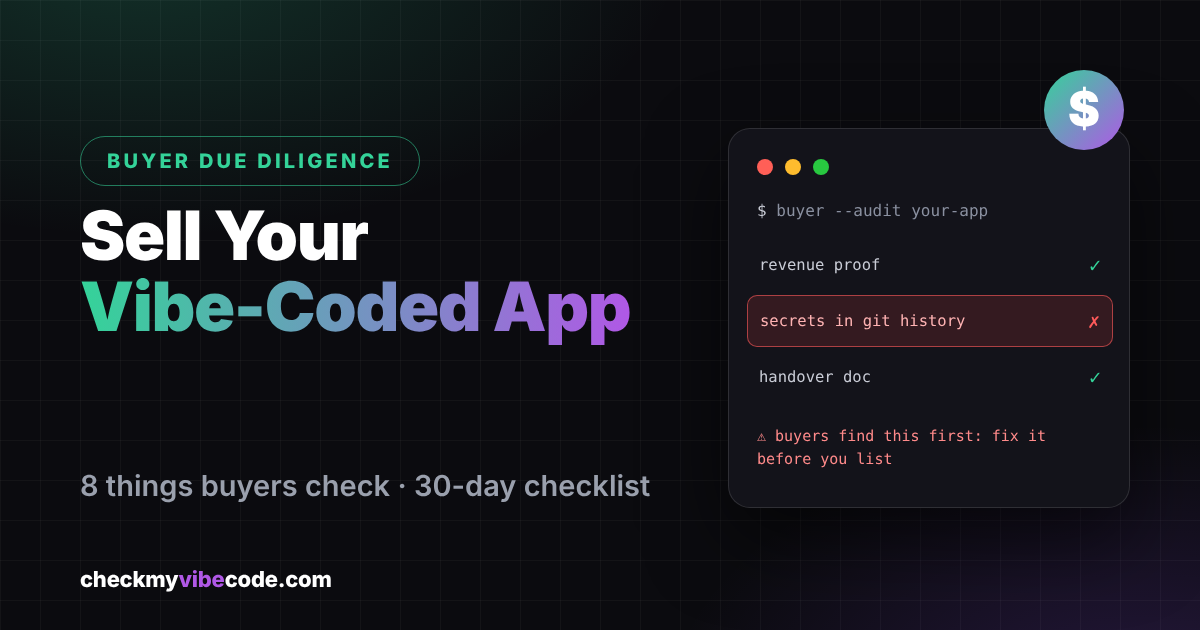
Yes, you can sell a vibe-coded app. Buyers pay for three things: proof of revenue, users who stay, and a codebase they can run and fix without you. That the code was written with AI is rarely the deal-breaker. What kills a sale is missing proof, unclear ownership, exposed secrets, an open database and no handover. Get these eight areas in order before you list, and you remove most reasons for a buyer to walk away or lower the price.
Yes. A buyer does not care which tool wrote the code. They care whether the business works and whether they can take it over. A small app with paying users and a clean handover is easier to sell than a clever app nobody uses.
A buyer is really paying for what the app earns and keeps. That means monthly revenue they can verify, users who come back, and a setup they can run on their own accounts within days. Code quality matters because it decides how much work the buyer must do after the sale, and that work comes off your price.
Vibe-coded apps do get extra scrutiny, and the reasons are fair. AI tools often leave secrets in the repo, skip database access rules and write few tests. A buyer who finds one of these will ask what else is wrong, so it pays to find these problems yourself first.
Buyers check eight areas, and most of them are about trust, not code style. Use this table as your own audit before you list.
| # | Area | What the buyer looks for | How to prepare |
|---|---|---|---|
| 1 | Revenue proof | Payment-provider export that matches your claimed monthly revenue; refunds and failed payments | Export 12 months from your payment provider, keep bank statements that match |
| 2 | Users and churn | Active users, signups over time, how many paying users cancel | Pull numbers straight from your database or analytics, not from memory |
| 3 | Code ownership and licenses | Who wrote the code, open-source licenses, brand and domain ownership, AI tool terms | List every dependency and its license, move domain and accounts to a company or your name only |
| 4 | Security | Secrets in the repo or git history, open database tables, exposed keys, outdated packages | Scan your repo and history for keys, rotate anything exposed, turn on database access rules, update dependencies |
| 5 | Code quality and tests | Can someone else run it, change it and know it still works? | Add a README with setup steps, keep tests passing, remove dead code |
| 6 | Hosting and costs | What it costs per month, who owns the accounts, how hard a move is | Write down every service, its bill and login owner; make the deploy repeatable |
| 7 | User data and privacy | What personal data you hold, consent records, a privacy policy that matches reality | Document what you store, delete what you do not need, keep consent logs |
| 8 | Handover and documents | A written guide to run, deploy and fix the app; a support plan for the first weeks | Write a handover doc, offer 2 to 4 weeks of paid or included support |
If you can only fix three things, fix revenue proof (1), security (4) and handover (8). They decide whether a buyer trusts the rest.
Spend one week each on proof, security, code and handover.
You can sell through a marketplace, a community, or direct outreach, and the deal usually runs as an asset sale with a handover period. Check each platform's current rules and fees before you list, because they change.
| Route | Good for | Watch out for |
|---|---|---|
| Micro-SaaS and startup marketplaces (for example Acquire.com or Flippa) | Apps with revenue and a clear story; many buyers in one place | Listing fees or commissions, lots of low offers, buyers who only ask for data |
| Indie and founder communities | Small apps and warm buyers who know your product | No escrow or contract help, so you need your own paperwork |
| Direct outreach to companies in your niche | Apps that solve a niche problem for a company that already has the users | Takes time; you must sign an NDA before sharing code or numbers |
Typical deal terms to discuss, in plain words:
Get a lawyer and a tax adviser to look at the contract. This article is general information, not legal or tax advice.
Yes. Buyers pay for revenue, users and a codebase they can run. The tool that wrote the code matters far less than proof, security and a clean handover.
It depends mostly on verified revenue, profit and growth, not on the code. Buyers usually price a business as a multiple of its profit, and the multiple varies by market and size. Look at recent sales on the marketplace you plan to use instead of trusting a rule of thumb.
Less than you might expect. They care whether the app runs, is secure, has documentation and can be changed by someone else. AI-written code with a README, tests and no exposed secrets beats hand-written code with none of these.
Secrets left in the repository or its history, database tables without access rules, and outdated packages with known vulnerabilities. All three are quick to check yourself before you list.
Not always. Many small apps are sold as assets by the person who owns them. Tax and liability depend on your country and situation, so ask a tax adviser before you sign. This is not legal or tax advice.
Code Check on CheckMyVibeCode.com runs fixed rules against your live site or a GitHub link: security headers, vulnerable dependencies and exposed key formats. AI only explains the findings. It does not replace a full audit, but it finds the quick problems a buyer would find first. Disclosure: I run that site.
This guide is based on common due-diligence practice for small software sales and on the author's experience building and running a vibe-coded product. It quotes no market figures. Check marketplace fees, rules and tax treatment on the providers' own pages and with a professional before you act.
Written by Mio, founder of CheckMyVibeCode.com.